Unlock Virtual Guitar Music Theory: Play Chords Online That Sound Amazing
Ever wondered why some guitar chords just "click" when played in sequence, creating a satisfying melody, while others sound clunky and out of place? This isn't magic; it's the power of guitar music theory. Have you ever wanted to write your own songs but felt stuck choosing the right chords? This guide will demystify the simple principles behind musical harmony, empowering you to understand, create, and play beautiful chord progressions. Best of all, you can put it all into practice immediately on our free online guitar.
Feeling a bit intimidated by music theory? Don't be! Think of it less as a dusty textbook and more like a secret map to why your favorite songs sound so good. Grasping just a few core ideas can totally transform your playing, moving you beyond simply copying tunes to truly owning your musical expression. It unlocks your ability to improvise, write original music, and learn new songs faster. We'll break down the essentials in a way that's easy to grasp, so you can start making music that sounds amazing right away.

Understanding the Musical Key on Your Virtual Guitar
The first step in understanding why chords sound good together is the concept of a musical key. Think of a key as the "home base" or central point for a piece of music. It’s a family of notes that have a strong relationship with each other, creating a sense of stability and resolution. When a song is in the "key of G," for example, it means the G note and its related G chord feel like the ultimate destination, the place where the music feels resolved and complete.
This concept is crucial for anyone learning to play guitar online, from "Aspiring Guitarists" to "Bedroom Producers." For beginners, knowing the key helps you predict which chords will appear in a song. For songwriters, the key provides a framework for building progressions that feel cohesive and emotionally resonant. It’s the foundation upon which countless hit songs are built.
What is a Musical Key on Guitar, Really?
On the guitar, a musical key is defined by a starting note (the root) and a specific pattern of intervals that create a scale. This scale provides all the notes you'll need to build both your melodies and your chords. When all the elements of a song are derived from the same key, they naturally sound harmonious and connected. It’s like all the ingredients in a recipe coming together to create one delicious, unified flavor.
Playing within a key ensures that your music has a consistent mood and direction. Straying from the key can create tension or dissonance, which is a powerful tool when used intentionally, but can sound like a mistake if done by accident. By understanding keys, you gain control over the emotional journey of your music.
Building the Major Scale: The DNA of Harmony
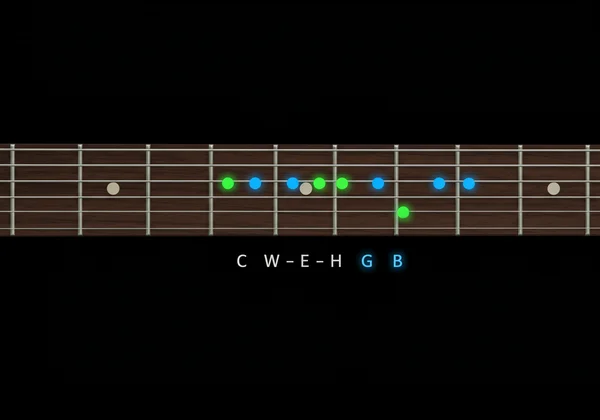
The single most important building block of any musical key is the major scale. It’s the sonic DNA from which melodies and chords are born. You probably already know its sound: Do-Re-Mi-Fa-So-La-Ti-Do. This sequence of notes isn't random; it follows a specific pattern of whole steps (W) and half steps (H) on the guitar fretboard: W-W-H-W-W-W-H.
Let's use the key of C Major as an example since it has no sharp or flat notes, making it simple. The notes are C, D, E, F, G, A, B. This collection of seven notes is your palette. From these seven notes, you can build every standard chord that belongs to the key of C Major. Understanding this principle is the key to unlocking countless guitar chord progressions. You can map this out right now on our virtual guitar tool to see how it works.
The Core Chord Families: I-IV-V-vi Progressions Explained
Now that we know a key gives us a set of notes (the major scale), the next step is to build chords from those notes. This is where we answer the big question: why chords work together. Each note in the scale can be used as the root note for a chord. By stacking specific notes from the scale on top of each root, we create a family of chords that are all related and sound fantastic together.
In music theory, we number these chords using Roman numerals (I, ii, iii, IV, V, vi, vii°). The uppercase numerals represent major chords, while the lowercase ones are minor. For any major key, the I, IV, and V chords will always be major, while the ii, iii, and vi chords will be minor. This pattern is universal across all twelve keys.
Building Chords for Your Virtual Guitar: From Scales to Song
Let's return to our C Major scale (C, D, E, F, G, A, B). If we build a basic three-note chord (a triad) on each note using only other notes from that same scale, we get the following family of chords:
- I: C Major (C-E-G)
- ii: D minor (D-F-A)
- iii: E minor (E-G-B)
- IV: F Major (F-A-C)
- V: G Major (G-B-D)
- vi: A minor (A-C-E)
- vii°: B diminished (B-D-F)
These seven chords are the complete chord family for the key of C Major. Any combination of these chords will sound musically correct and harmonious. This simple formula is the secret behind thousands of songs across every genre.
The Power of I-IV-V: Classic Progressions for Any Song
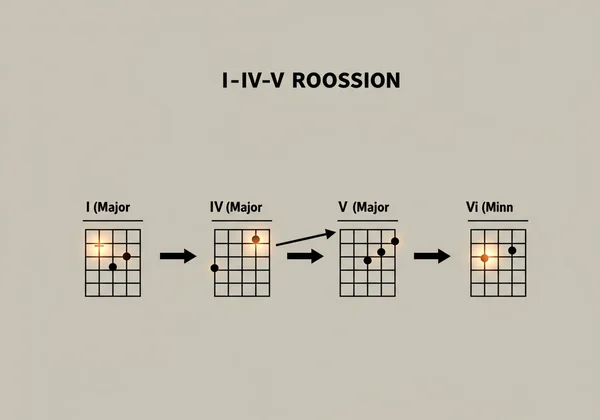
The strongest and most fundamental relationship between chords in any key is the one between the I, IV, and V chords. The I chord (the tonic) is your home base. The V chord (the dominant) creates a powerful sense of tension that desperately wants to resolve back to the I chord. The IV chord (the subdominant) provides a gentle lift away from home before leading to the V.
This I-IV-V movement is the backbone of blues, rock, pop, and country music. In the key of G, this would be G-C-D. In the key of D, it would be D-G-A. Once you understand this relationship, you'll start hearing it everywhere. You can experiment with these classic guitar chord progressions on our online guitar simulator to truly feel their power.
Adding Emotion with the Minor vi Chord
While the I-IV-V progression is powerful, adding the vi chord opens up a whole new world of emotional possibilities. The vi chord is the "relative minor" of the I chord, meaning it shares many of the same notes but has a sadder, more reflective quality. It’s the secret ingredient in countless pop and rock ballads.
The progression I-V-vi-IV is often called the "four chords of pop" for a reason. In the key of C, that’s C-G-Am-F. Think of songs like "Let It Be" or "Don't Stop Believin'." This progression has a timeless, heartfelt feel that resonates with listeners. By learning to incorporate the vi chord, you can add incredible depth to your songwriting.
Practical Application: Craft Your Own Chord Progressions on Our Online Guitar
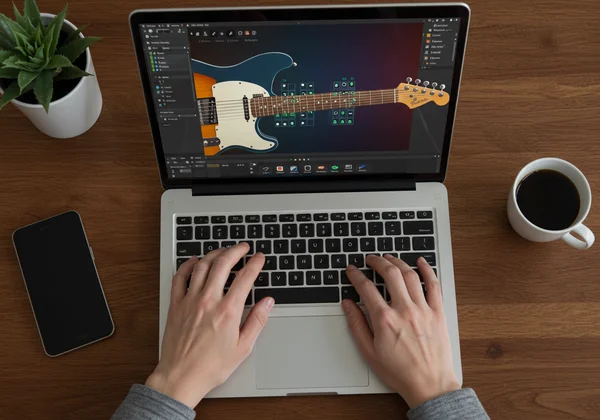
Theory is great, but music is meant to be played. The best way to internalize these concepts is to apply them. Our interactive virtual guitar is the perfect sandbox for this. You don't need a physical instrument or any expensive software—just your browser and your creativity. This is where you can truly get hands-on experience and build confidence.
By using our tool, you can immediately test out the chord progressions we've discussed. You can hear the difference between a major I chord and a minor vi chord. You can feel the tension of the V chord resolving to the I. This direct feedback loop is the fastest way to turn abstract knowledge into practical musical skill.
Experimenting with Virtual Guitar Chords: Practical Changes
Here’s a simple exercise to get you started. Go to VirtualGuitar.org and get ready to play. Let's work in the key of C Major.
-
Find Your Chords: Locate the C (I), F (IV), G (V), and Am (vi) chords. You can play them easily using your computer keyboard.
-
Play the I-IV-V: Strum a simple pattern: C - C - F - F - G - G - C - C. Feel how the G naturally leads you back home to the C chord.
-
Introduce the Minor: Now, try the famous I-V-vi-IV progression: C - G - Am - F. Notice the more emotional, thoughtful mood this creates.
-
Mix and Match: Don't stop there! Try creating your own patterns. What does I-vi-IV-V sound like? Experiment freely and let your ear guide you.
Unleash Your Inner Songwriter: Ideas for Your First Original Progression
Ready to create something of your own? Start simple. Pick a key—G Major is another popular one for guitarists (I=G, IV=C, V=D, vi=Em). Hum a simple melody and try to find chords that fit underneath it from your chosen key's chord family.
Don’t worry about making it perfect. The goal is to explore and have fun. Many famous songs were written with just three or four basic chords. Use our free virtual guitar as your musical sketchbook to jot down ideas and discover combinations that inspire you. This is the first step to unlocking your unique musical voice. Start creating music today!
Unlock Your Songwriting Potential with Our Free Virtual Guitar!
Understanding beginner music theory isn't about following rigid rules; it's about learning the language of music so you can express yourself more effectively. By grasping the concepts of keys, scales, and chord families, you've gained a powerful toolkit for creating music that sounds professional and emotionally compelling. The relationships between the I, IV, V, and vi chords are the foundation of Western music, and now they are yours to command.
Your musical adventure is just getting started! The concepts you learned today are the building blocks, not the final word. With this knowledge, you're now equipped to not just play, but truly understand the music you love. The most important thing is to keep playing, experimenting, and listening. We invite you to continue your exploration at VirtualGuitar.org. Whether you're practicing scales, testing progressions, or writing your first masterpiece, our tool is here to support you every step of the way.
Frequently Asked Questions About Guitar Music Theory
How can I use the online virtual guitar to practice these chord progressions?
Our virtual guitar is perfect for practice. The interface allows you to play chords with your computer keyboard, making it easy to switch between them smoothly. You can load up the site, choose a guitar tone you like, and play through the I-IV-V-vi progressions in any key to train your ear and learn how they feel. It's an ideal, zero-cost way to practice these chords anytime.
Is learning music theory essential for playing guitar?
While not strictly essential—many great musicians play by ear—learning basic theory is like getting a cheat sheet for music. It accelerates your learning, helps you understand why the music you love sounds so good, and gives you the tools to create your own original material. It empowers you to move beyond simply copying others.
What's the easiest key to start learning beginner music theory in?
The keys of C Major and G Major are fantastic starting points. C Major has no sharps or flats, making the notes on the scale (C, D, E, F, G, A, B) very straightforward. G Major has only one sharp (F#) and its core chords (G, C, D, Em) are among the most common and physically easy to play on a real guitar, which translates to simple patterns on a virtual instrument.
Can I apply this theory to different virtual guitar tones?
Absolutely! Music theory is universal. A C-G-Am-F progression will sound great whether you're playing it on our virtual acoustic guitar for a mellow, singer-songwriter vibe, or switching to the virtual electric guitar with some grit for a rock anthem. Experimenting with different tones can show you how the same progression can take on a completely different mood and style.