Silent Guitar Practice: Apartment-Friendly Exercises Using Virtual Guitar Tools
Do you love the guitar but live in an apartment, dorm, or shared space? Are you tired of worrying about bothering your neighbors, roommates, or family every time you want to practice? For many aspiring musicians, the joy of learning is often silenced by the fear of making too much noise. This common dilemma can slow your progress and kill your motivation.
Fortunately, there's a powerful solution waiting for you that lets you practice anytime, anywhere, without making a sound. Let's explore how you can keep your musical dreams alive while respecting your living space! Silent guitar practice, especially when combined with modern digital tools, can revolutionize how you learn. This guide will walk you through effective, apartment-friendly exercises that build real skills. We’ll show you how a tool like our online virtual guitar can become your secret weapon for quiet, productive practice sessions.

Why Silent Guitar Practice is Your Apartment Solution
For anyone living in close quarters, the idea of quiet practice is a game-changer. It's not just about avoiding noise complaints. It's about unlocking the freedom to practice whenever inspiration strikes, whether it's late at night or early in the morning. Let's explore why this method is so effective for city dwellers and students.
The Noise Dilemma: Why Acoustic Practice is Challenging in Small Spaces
Acoustic guitars are designed to be heard. Their resonant bodies amplify every strum, pluck, and mistake. This is great for a campfire but less ideal for a thin-walled apartment. The sound travels easily, making it nearly impossible to practice without disturbing others.
This leads to a frustrating cycle. You might practice less often or shorten your sessions. You might even play so softly that you don't build proper technique. Many beginners get discouraged and give up entirely, believing their living situation makes learning impossible. The noise dilemma is a real barrier, but it’s one you can overcome.
Benefits of Silent Practice: Beyond Just Being Quiet
The most obvious benefit of silent practice is peace and quiet. However, the advantages go much deeper. They help you build a stronger foundation as a guitarist. By removing the element of sound, you force your brain and hands to focus on other crucial aspects of playing.
Silent practice improves:
- Muscle Memory: You can concentrate purely on finger movements and chord shapes.
- Rhythmic Accuracy: Without melody to distract you, your focus shifts to keeping a steady, precise rhythm.
- Fretboard Knowledge: Visualization exercises strengthen your mental map of the notes and scales on the guitar neck.
- Confidence: You can freely make mistakes and repeat exercises without feeling self-conscious.
These benefits make silent practice a valuable supplement to your regular playing, not just a temporary fix.
Muted Strumming Techniques: Building Rhythm Without Sound
One of the most effective forms of silent practice is muted strumming. This technique involves dampening the strings with your fretting or picking hand. They produce a percussive "click" instead of a musical note. It's a fantastic way to master rhythm, a skill that is 50% of what makes a great guitarist.
Basic Palm Muting: The Foundation of Silent Strumming
Palm muting is a core technique in many music genres, from rock to country. For silent practice, it's your best friend. To do it, gently rest the side of your picking hand on the strings, right near the bridge where the strings meet the guitar's body.
When you strum, the strings should sound dull and percussive, not ring out. Experiment with the pressure and placement of your hand. Too much pressure will completely silence the strings, while too little will let them ring. Finding that sweet spot is key. You can practice this physical motion on a real guitar or simply imagine it while using an online tool.
Developing Rhythmic Patterns: From Simple to Complex
Once you're comfortable with the muted sound, you can start working on rhythm. Begin with the basics. Set a slow, steady tempo and practice simple down-strums on each beat: "down, down, down, down." Count "1, 2, 3, 4" out loud or in your head.
From there, introduce up-strums between the beats: "down-up, down-up, down-up, down-up." This "eighth-note" pattern is the backbone of countless songs. You can find endless strumming patterns online to practice. The goal is to make your movements smooth, consistent, and perfectly in time—all without making any real noise.
Transferring Silent Practice to Real Playing
The beauty of this exercise is its direct application to real playing. After drilling a complex strumming pattern silently, your picking hand will have the muscle memory locked in. When you finally lift your palm and let the chords ring out, you'll be amazed at how clean and confident your rhythm sounds.
You can supercharge this process by practicing along with our free online guitar. Even though you're practicing silently, seeing the virtual fretboard helps you coordinate your chord changes with your newly mastered strumming patterns.
Fretboard Visualization: Strengthening Your Mental Guitar Skills
Great guitar playing isn't just about fast fingers; it's also about a sharp mind. Fretboard visualization is a powerful mental exercise you can do anywhere, with or without a guitar. It involves creating a clear mental image of the guitar neck and "seeing" yourself play scales, chords, and melodies.
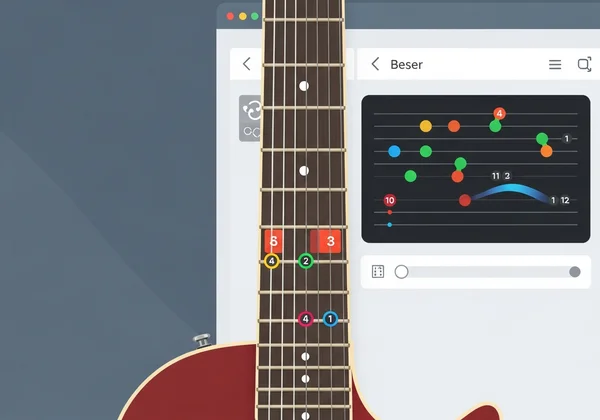
Note Recognition on the Virtual Fretboard
How well do you know the notes on the guitar neck? For many players, the answer is "not very well." Silent practice is the perfect time to fix this. Use an online tool that shows the fretboard clearly. Pick a string, like the low E string, and mentally name each note as you go up the frets: F, F#, G, G#, and so on.
Challenge yourself to find all the 'C' notes on the entire fretboard. Then find all the 'G' notes. This exercise builds a powerful mental map that will make learning music theory and improvising solos much easier later on. It’s a quiet exercise with loud results.
Chord Shape Memorization Without Physical Movement
Changing chords smoothly is one of the biggest hurdles for beginners. You can practice this silently by visualizing the chord shapes. Close your eyes and picture the shape for a G major chord. See where each finger goes. Now, "lift" your mental fingers and move them to a C major chord shape.
Repeat this mental transition over and over. G to C. C to D. D to G. By rehearsing these movements in your mind, you are training your brain and preparing your muscles. When you pick up a real guitar, the physical movements will feel far more natural and automatic. Using a virtual guitar tool can provide a perfect visual reference for this exercise.
Mental Scale Practice: Visualizing Patterns Anytime, Anywhere
Just like with chords, you can practice scales entirely in your head. Start with a simple pattern, like the C major scale. Visualize the starting note on the fretboard and "play" the entire scale up and down in your mind, one note at a time.
Pay attention to the pattern of whole steps and half steps. This mental repetition solidifies your knowledge of the scale, making it second nature when you need it. This is the ultimate apartment-friendly exercise. You can do it on the bus, while waiting in line, or just before you fall asleep—all without making a sound.
Rhythm Games and Pattern Drills: Making Silent Practice Fun
Let's be honest: silent drills can sometimes feel a bit dry. The key to sticking with it is to make your practice sessions engaging and fun. This is where combining silent techniques with interactive tools can make a huge difference. It can turn quiet practice into an enjoyable game.
Virtual Metronome Integration: Keeping Time Without Disturbing Others
A metronome is a guitarist's most important tool for developing a rock-solid sense of time. But a clicking physical metronome can be just as annoying as a guitar. The solution? A visual or virtual metronome.
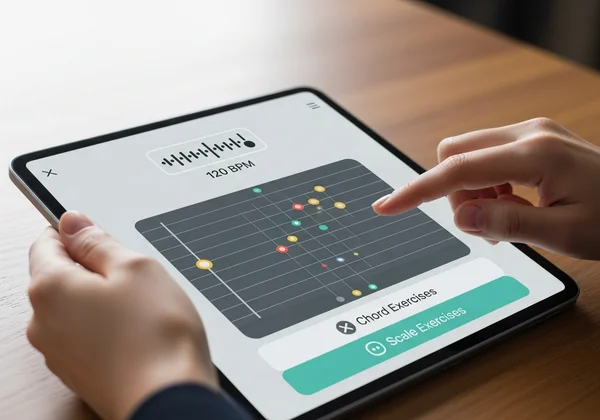
Many online tools and apps offer a silent, flashing metronome. You can use this visual cue to practice your muted strumming or finger exercises perfectly in time. Our interactive guitar simulator is designed for this, allowing you to focus on your timing without adding any noise to your environment. It's a simple feature that makes a world of difference for apartment practice.
Finger Independence Exercises on Virtual Guitar
Strong, independent fingers are crucial for playing clean chords and fast lead lines. You can build this strength silently. Place your fretting hand on a table or your leg as if it were a guitar neck. Practice "spider walks" by moving your fingers one by one, as if you were walking them up and down the frets.
Try lifting your ring finger while keeping your other three fingers down. Then try lifting just your pinky. These simple, silent movements build dexterity and control. You can visualize the fretboard on our virtual tool as you do them, connecting the physical exercise to the musical application.
Creating Your Silent Practice Routine
The best way to see results is to be consistent. Create a simple, 15-minute silent practice routine that you can do every day. Dedicate five minutes to each of the core areas we've discussed.
- 5 minutes: Muted strumming. Work on two or three different rhythmic patterns.
- 5 minutes: Fretboard visualization. Focus on memorizing the notes on one string or practicing three chord changes.
- 5 minutes: Finger independence drills. Use a virtual metronome to keep time.
This short, daily routine will dramatically accelerate your progress, all without disturbing a single person.
Living in an apartment or dorm should never be a barrier to your musical dreams. By embracing silent guitar practice, you can turn a limitation into a strength. You'll build a stronger rhythmic foundation, a deeper understanding of the fretboard, and better muscle memory—all while keeping the peace with your neighbors.
Remember, the key is to focus on what you can do. Practice muted strumming to perfect your rhythm, use visualization to master chords and scales, and perform finger exercises to build dexterity. These techniques are not just temporary solutions; they are powerful tools that will make you a better guitarist.
Ready to put these exercises into action? The best way to start is with a clear, interactive visual aid. Head over to VirtualGuitar.org and use our free tool as your silent practice companion. See the fretboard, visualize the chords, and start your journey to silent guitar mastery today.
Can I really learn guitar effectively without making any sound?
Absolutely. While hearing the notes is important, a significant part of learning guitar involves muscle memory, rhythm, and fretboard knowledge. Silent practice allows you to isolate and focus on these foundational skills without distraction. This can actually accelerate your progress when you do play out loud.
How often should I practice these silent exercises?
Consistency is more important than duration. A focused 15-20 minute silent practice session every day will yield far better results than one long, infrequent session. Try to integrate it into your daily routine, just like brushing your teeth.
Will silent practice help me transition to acoustic guitar playing?
Yes, definitely. The skills you build during silent practice—like rhythmic precision, clean chord changes, and fretboard visualization—transfer directly to a physical guitar. When you pick up an acoustic, you'll find that your hands already know what to do, making the transition much smoother. To make it even easier, you can try out different tones on our virtual guitar to get a feel for acoustic, electric, and classical sounds.