Master Barre Chords on Virtual Guitar: Play Guitar Online Practice Guide
Let’s be honest. For many aspiring guitarists, barre chords are the first major roadblock. You remember the feeling: the frustrating buzz of muted strings, the ache in your hand trying to press down all six strings, and the infamous F chord that seems impossible to master. It’s enough to make anyone want to quit.
But what if you could build the muscle memory and chord-shape knowledge for barre chords without the physical pain?
That’s where online tools can change the game. By removing the physical struggle, you can focus on the most important parts: understanding the shapes, memorizing the finger patterns, and learning how to change chords smoothly. With a tool like our online guitar, you can practice these essential skills anytime, anywhere, and finally conquer the techniques that unlock thousands of new songs.
This guide will show you how to use a virtual guitar to master barre chords. We'll cover why this method is so effective, the essential shapes you need to know, and practice drills that will make your transitions clean and fast.
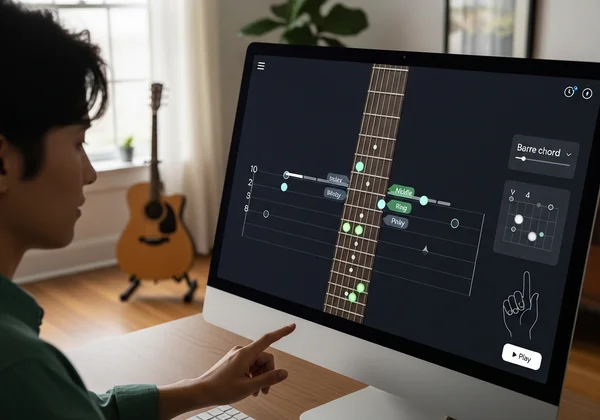
Why Practice Barre Chords with a Virtual Guitar?
Before diving into the "how," let's explore the "why." Using a virtual instrument for a physical technique might seem strange at first, but it offers powerful advantages that accelerate your learning. It’s not about replacing a real guitar, but about supplementing your practice in a smarter way.
Overcome Physical Barriers to Barre Chord Mastery
The biggest challenge with barre chords isn't theoretical; it's physical. You need significant finger strength to hold down multiple strings firmly, and developing calluses takes time. This initial struggle often distracts from the actual goal: learning the chord.
A virtual guitar eliminates these barriers completely. There’s no string tension to fight against and no pain in your fingertips. This allows you to focus 100% of your attention on the chord shape and the notes you’re supposed to be playing. Practice F major for an hour—no fatigue. Embed the pattern in your brain. Then, real guitar feels easy.
The Advantage of Online Barre Chord Practice Methods
Convenience is a huge factor in building a consistent practice habit. An online tool offers flexibility that a physical instrument sometimes can't. You can pull up a virtual guitar on your computer during a lunch break, on a bus, or late at night without disturbing anyone.
An online guitar simulator gives instant feedback. Hit the keys right? Hear a perfect chord every time. This positive reinforcement helps build your confidence and trains your ear to recognize what the chord should sound like. You won't be discouraged by the buzzing and muting that often happens when you’re just starting out on a real fretboard. This makes online practice a powerful and motivating tool.
Essential Barre Chords Virtual Guitar Shapes for Beginners
Barre chords seem intimidating because there are so many of them. But here’s the secret: most barre chords are based on just two fundamental, movable shapes derived from open chords you already know—E and A. Once you learn these two shapes, you can play a major chord on any fret on the neck.
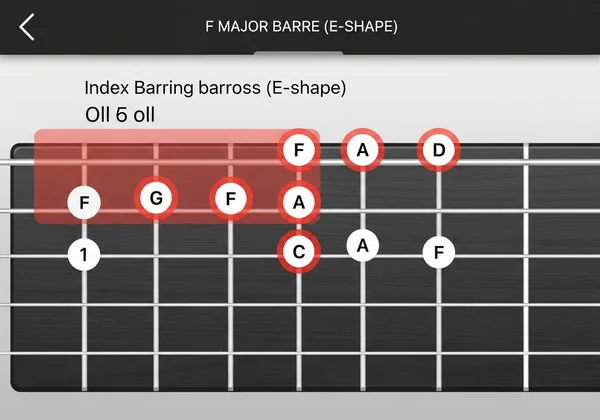
Mastering the F Major (E-Shape) Barre Chord
The F major chord is the classic "E-shape" barre chord. It's called this because if you remove the "barre" (your index finger), the remaining fingers form a standard open E major chord shape.
Here’s how to visualize it on a virtual guitar:
-
Locate the First Fret: This is the first column of notes on the virtual fretboard.
-
Form the Barre: Imagine your index finger pressing down on all six strings at the first fret. On the virtual guitar tool, this means you'll be activating notes on that fret.
-
Add the "E" Shape: Now, place your other fingers in the shape of an E major chord, but moved up one fret. Your middle finger will be on the 3rd string (G string) at the 2nd fret, your ring finger on the 5th string (A string) at the 3rd fret, and your pinky on the 4th string (D string) at the 3rd fret.
-
Strum with your Mouse or Keyboard: Listen to the bright, full sound of the F major chord. Practice forming this shape until it feels automatic.
Exploring the B Major (A-Shape) Barre Chord
The second essential shape is the "A-shape." This one is based on the open A major chord. A common example is the B major chord, which is often tricky for beginners.
Let's break it down:
- Locate the Second Fret: This is where you will form your barre.
- Form the Barre: Imagine your index finger pressing down on the first five strings (from the A string to the high E string) at the second fret.
- Add the "A" Shape: Bar strings 4, 3, and 2 at fret 4 with your ring finger. Tricky? Virtual keyboard makes it simple—just press the right keys.
- Play the Chord: Strum the chord and listen. This is a B major. Now, slide this entire shape up two frets, and you have a C# major. This movability is what makes barre chords so powerful.
Tips for Clean Finger Placement on the Virtual Fretboard
Even on a virtual instrument, thinking about proper technique helps. When you practice on our virtual guitar, use the keyboard mapping to your advantage.
- Visualize the Barre: Think of one key (like Shift or Space) as your "barre finger." Hold it down while you use other fingers to form the rest of the shape.
- Focus on One Note at a Time: Before strumming the whole chord, play each note individually to make sure you have the pattern right.
- Switch Tones: Try practicing with different guitar tones. A clean electric guitar tone can make it very clear if you're hitting the right notes, while an acoustic tone gives you a feel for how it will sound in a typical song.
Smooth Transitions: Play Barre Chords on Keyboard with Virtual Guitar
Knowing the shapes is one thing; changing between them smoothly is another. This is where drills and real-world application come in. The goal is to make these changes without long, awkward pauses.
Practice Drills for Quick Barre Chord Changes
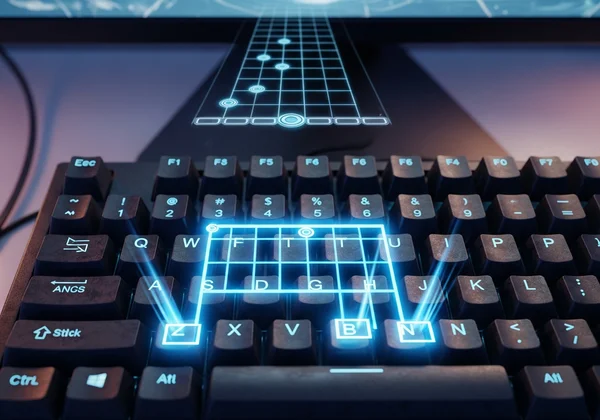
Repetition is your best friend. The keyboard interface of a virtual guitar is perfect for building the muscle memory needed for quick changes. Here are a couple of simple drills to get you started:
- The Four-Chord Wonder: Practice the most common progression in pop music: G -> C -> D -> Em. While some can be played as open chords, try playing them with barre shapes. For example, G (E-shape at 3rd fret) to C (A-shape at 3rd fret).
- The Minor-Major Switch: Practice moving between a minor and major chord on the same root note. A great example is moving from Am (open) to F major (E-shape barre at 1st fret), then to C major (open), and G major (open or barre).
- Use a Metronome: Set a slow tempo and try to change chords exactly on the beat. As you get more comfortable, gradually increase the speed.
Integrate Barre Chords into Simple Song Progressions
The best way to stay motivated is to apply what you've learned to actual music. Bedroom producers and songwriters will find this especially useful for quickly sketching out ideas.
Find the chords to one of your favorite songs and identify where the barre chords appear. A classic example is "Creep" by Radiohead, which uses a G -> B -> C -> Cm progression. Practicing the transition from B major (A-shape barre) to C major (A-shape barre one fret higher) is a fantastic exercise.
Use the free online tool to play along with the song. You can work out the tricky parts without getting tired, making your real-guitar practice sessions much more productive and fun.
Level Up Your Playing: Start with These Barre Chord Wins
Picture this: no sore fingers, just pure progress. That’s how our virtual guitar supercharges your practice. It helps you master the shapes without pain, build confidence with instant, clean feedback, and practice song progressions whenever you want. Barre chords are a gateway to a new level of playing, and the physical challenge should never be the reason you give up.
I remember nailing my first F barre chord—it was pure victory. You'll get there faster without the physical struggle. The journey to mastering barre chords is a marathon, not a sprint, and using the right tools makes that journey enjoyable and effective.
Ready to finally conquer barre chords? Start practicing on our virtual guitar right now, pull up the fretboard, and start practicing the F major shape. Your future self will thank you.

FAQ Section
Can I learn guitar online for free effectively with barre chords?
Yes! It won't build finger strength. But it nails the mental side. Memorize shapes perfectly and master transitions fast. You can understand how they move around the neck and practice transitions until they become second nature. Using a free tool like ours is an excellent way to supplement physical practice and accelerate your progress.
How to play guitar online with keyboard for complex chords like barre chords?
Our virtual guitar maps the fretboard to your computer keyboard. To play a barre chord, you simply press the combination of keys that correspond to the notes in that chord. For example, you might use one finger to hold down a key that represents the barre and your other fingers to press the keys for the rest of the shape. This simulates the action and helps you build the correct pattern in your mind.
What is the best virtual guitar website for practicing intermediate techniques?
For intermediate techniques like barre chords, you need a website that's simple, responsive, and distraction-free. Our virtual guitar is designed for this exact purpose. With its clean interface, multiple guitar tones, and intuitive keyboard controls, it helps you focus solely on the technique you're trying to master. It's the perfect digital companion for any guitarist looking to level up their skills. You can start practicing in seconds.