5 Intermediate Virtual Guitar Exercises: Build Speed & Dexterity
Are you feeling stuck after learning your first few chords? Many aspiring guitarists reach a point where their progress seems to slow down. You might know your open chords and a few scales, but your fingers do not feel fast or coordinated yet. How do you break through this intermediate plateau and reach the next level?
The secret to moving forward is focused, technical practice. While playing songs is fun, specific drills build the muscle memory needed for complex solos and faster rhythms. Even without a physical instrument nearby, you can use a virtual guitar to master these essential movements. This guide walks you through five proven exercises designed to boost your speed and dexterity.
By using an interactive tool, you can visualize the fretboard and practice your timing anywhere. Whether you are at your desk or on a break, these drills develop the finger strength and coordination required for advanced playing. Let’s dive into the technical foundations that will transform your musical abilities.

Building Technical Foundation with Alternate Picking Drills
Alternate picking is the engine that drives fast guitar playing. Instead of only picking "down," you alternate between downstrokes and upstrokes. This movement is efficient and allows you to play twice as fast with half the effort. On a digital interface, this translates to precise timing and quick finger movements—so get clicking to sharpen your skills.
Developing a strong picking foundation is about more than just speed. It is about "synchronization"—ensuring your fretting hand and your picking hand hit the note at the exact same moment. If they are even slightly off, the music sounds messy. Using a free online guitar allows you to hear these discrepancies clearly so you can fix them.
The 1-String Alternate Picking Matrix
The 1-String Matrix is the perfect starting point for intermediate players. It focuses on one string at a time to eliminate the distraction of jumping between strings. To do this exercise, choose a single string on the virtual fretboard and play a sequence of four notes using four different fingers.
- Place your index finger on the 5th fret, middle on the 6th, ring on the 7th, and pinky on the 8th.
- Play the notes in order: 5, 6, 7, 8.
- As you play, alternate your strokes: Down, Up, Down, Up.
- Reverse the order: 8, 7, 6, 5 (Up, Down, Up, Down).
The goal is not speed at first. Focus on making every note sound exactly the same in volume and duration. This drill builds incredible finger independence, especially for your pinky, which is often the weakest finger for intermediate players.
Cross-String Picking Patterns for Virtual Guitar
Comfortable with one string? Try cross-string patterns next. Real playing rarely stays on one string, and this drill builds essential coordination. You need to be able to jump from the low E string to the D string without hesitation.
Try this pattern on the virtual guitar:
- Play the 5th fret on the E string (Downstroke).
- Jump to the 5th fret on the D string (Upstroke).
- Move to the 7th fret on the A string (Downstroke).
- Jump to the 7th fret on the G string (Upstroke).
This "zigzag" motion teaches your brain to map out the distances between strings. On a computer keyboard, this exercise improves your spatial awareness of the interface. It mimics the complexity of professional riffs and prepares you for lead guitar parts.
Hammer-Ons and Pull-Offs: Creating Fluid Legato Lines
If alternate picking is the "percussive" side of guitar, legato is the "vocal" side. Legato involves playing multiple notes with a single pick stroke. You use your fretting fingers to create the sound through hammer-ons and pull-offs. These techniques make your playing sound smooth, connected, and professional.
Legato is essential for genres like blues, jazz, and rock. It allows you to play fast runs that sound "liquid" rather than "staccato." Practicing these on an online tool helps you understand the logic of note connections before you even pick up a physical guitar.

Single-String Legato Exercises for Speed Development
To build the strength needed for legato, you must practice "trills." A trill is a rapid succession of hammer-ons and pull-offs between two notes. This is a high-intensity exercise for your finger muscles.
Start by picking a note on the 5th fret with your index finger. Without picking again, "hammer" your ring finger down onto the 7th fret. Immediately "pull" it back off to let the 5th fret ring out. Repeat this motion as long as you can sustain the sound.
This drill targets the small muscles in your hand. Stronger fingers lead to faster playing and better control. It is one of the most effective intermediate guitar exercises for building the stamina required for long solos.
Position Shifting with Hammer-Ons/Pull-Offs
Intermediate players often get "stuck" in one box on the fretboard. To break out, you need to practice shifting positions while maintaining a fluid sound. Position shifting involves moving your entire hand up or down the neck while playing.
Try this sequence:
- Hammer-on from the 5th to the 7th fret.
- Slide your index finger up to the 8th fret.
- Hammer-on from the 8th to the 10th fret.
- Pull-off from the 10th to the 8th.
Combine hammer-ons and slides for seamless flow. This exercise unlocks horizontal movement across the fretboard—not just vertical patterns. It teaches you how to navigate the virtual guitar fingerboard horizontally and opens up the whole neck for your creative ideas.
Rhythm Precision: Beyond Basic Strumming Patterns
Many intermediate students focus so much on their fingers that they forget about their "internal clock." Rhythm is the most important part of music. Even if you play the right notes, the music will fail if the timing is off. Developing rhythmic precision separates a bedroom hobbyist from a performing musician.
At the intermediate level, you must move beyond simple "Down-Down-Up-Up" strumming. You need to master subdivisions—the ability to divide a beat into equal parts. You can use the online guitar simulator to test your ability to stay on beat with complex patterns.
Syncing Your Hands with Metronome Practice
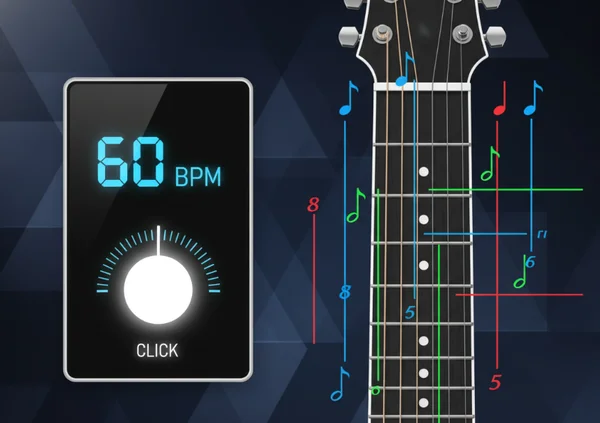
A metronome is a guitarist's best friend. Set a metronome to a slow tempo, like 60 Beats Per Minute (BPM). Every time the metronome clicks, you should hit a note perfectly.
- Quarter Notes: Play one note per click.
- Eighth Notes: Play two notes per click (Down-Up).
- Sixteenth Notes: Play four notes per click (Down-Up-Down-Up).
Stay "in the pocket." If you rush or lag behind the click, reduce the tempo and rebuild accuracy first. This discipline ensures that when you play with a band or a backing track, your music feels solid and professional.
Complex Rhythm Patterns in Virtual Guitar
Once you have mastered the metronome, start experimenting with "syncopation." Syncopation means emphasizing the "off-beats"—the spaces between the clicks. This is the foundation of funk, reggae, and modern pop music.
On the virtual guitar practice interface, try to play a chord on every "and" of the beat (1 and 2 and 3 and 4 and). This requires a high level of mental focus. It forces you to stop relying on the heavy "1" beat and start feeling the subtle grooves. These dexterity drills for rhythm will make your playing much more interesting to listen to.
Ready to Level Up Your Skills?
These drills turn abstract practice into real progress. Moving from a beginner to an intermediate player is one of the most exciting phases because you finally have the tools to express yourself. By focusing on alternate picking, legato techniques, and rhythmic precision, you are building a professional foundation.
Remember that consistency is more important than duration. Practicing for 15 minutes every day is much better than practicing for three hours once a week. These exercises are designed to be short and effective. You do not need a lot of equipment to improve; you just need the right approach.
Now is the time to put these theories into practice. Head over to the homepage and use the virtual guitar tool to start these drills. Try the 1-String Matrix or the metronome sync exercise right now. With every click and every note, you are becoming a better musician. Grab your keyboard and try the 1-String Matrix right now—your fingers will thank you later!
FAQ Section
How often should I practice these intermediate exercises?
For the best results, aim to practice for at least 15 to 20 minutes every day. Consistency helps your brain and fingers build permanent muscle memory. Even a short session on a virtual guitar during a lunch break can keep your skills sharp and prevent you from getting "rusty."
Can I really build guitar skills using only a virtual platform?
Yes! While a physical guitar is necessary for some tactile nuances, a virtual platform is excellent for learning fretboard logic, scale shapes, and rhythmic timing. It is a powerful practice tool that helps you visualize the music and train your ears. Many producers and songwriters use these tools to map out complex melodies before recording.
What's the best way to track my progress with these exercises?
The best way to track progress is by using a metronome. Write down the maximum BPM (beats per minute) at which you can play an exercise perfectly. As you get faster, update your log. Seeing your speed go from 60 BPM to 80 BPM over a month is a great way to stay motivated.
How do these exercises translate to playing a real guitar?
The mental patterns you build—such as knowing where the notes are and understanding rhythmic subdivisions—translate 100% to a real guitar. The finger coordination you develop on a keyboard or touchscreen also helps with finger independence. This makes it much easier to transition your skills to physical strings.
Are there specific virtual guitar settings that enhance practice?
On VirtualGuitar.org, you can switch between acoustic, classical, and electric tones. For technical drills, the electric guitar setting is often best because it has a "sharper" attack. This makes it easier to hear if your timing is slightly off. Experiment with different tones to see which one helps you focus better on your dexterity drills.